In the field of materials science and product quality reliability verification, salt spray corrosion testing serves as a standardized method for evaluating the corrosion resistance of metallic materials, protective coatings, and electronic components. However, traditional natural environment exposure testing methods suffer from numerous inherent limitations: testing cycles often span several years, while results are susceptible to uncontrollable factors such as regional climate variations, seasonal changes, and environmental pollution, leading to poor data reproducibility, high result dispersion, and difficulty in establishing a comparable quantitative evaluation system. The Linpin (LINPIN) series of salt spray test chambers effectively overcomes these technical bottlenecks through artificial environment simulation technology, achieving a dual breakthrough in corrosion testing efficiency and precision.
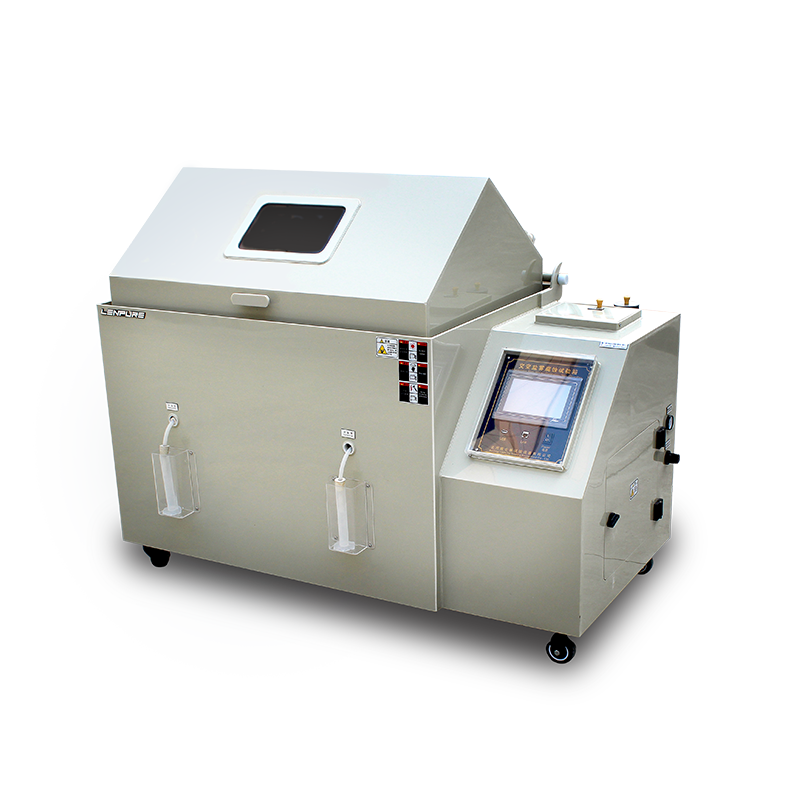
Artificial Environment Simulation Technology Principles and Acceleration Mechanism
The core technical advantage of salt spray test chambers lies in their ability to precisely construct a controllable salt spray corrosion environment within a limited volume. The equipment atomizes prepared electrolyte solutions into microscopic droplets through a compressed air spray system, forming a uniformly dispersed salt spray atmosphere in the sealed testing space. Compared with natural atmospheric corrosion processes, this simulation system can elevate sodium chloride concentration to 5%±1% (neutral salt spray test standard), or adjust pH values and chemical compositions according to testing requirements, achieving a salt spray deposition rate of 1-2ml/80cm²·h—far exceeding the natural environment level of 0.01-0.05ml/80cm²·h, typically reaching several to dozens of times the natural concentration.
This concentration gradient enhancement is established on rigorous physicochemical principles. According to Faraday’s corrosion electrochemical theory, corrosion rate is positively correlated with chloride ion activity in the electrolyte. By increasing salt spray concentration, the micro-cell reaction process on metal surfaces can be accelerated, causing corrosion product generation rates to grow exponentially, thereby compressing test time to 1/365 or even less of traditional methods while maintaining corrosion mechanism consistency. The equipment’s precision temperature control system can stabilize test temperature at 35℃±1℃ (NSS test standard) and maintain humidity above 95%, ensuring corrosion reactions proceed under constant kinetic conditions while effectively eliminating variables such as temperature fluctuations, humidity variations, and pollutant interference present in natural environments.
Comprehensive Coverage of Multi-Standard Test Systems
Linpin salt spray test chambers are compatible with multiple international and domestic standard-specified testing methods, primarily encompassing three typical modes:
The first is Neutral Salt Spray (NSS) testing, the earliest and most widely applied fundamental corrosion test, which uses a sodium chloride solution with pH 6.5-7.2, mainly for evaluating the corrosion resistance of metal substrates, anodic oxide layers, and organic coatings. The second is Acetic Acid Salt Spray (ASS) testing, which adjusts pH to 3.1-3.3 by adding glacial acetic acid to the salt solution, simulating acidic corrosion environments in industrial atmospheres, suitable for testing decorative platings and protective coatings’ acid resistance. The third is Copper-accelerated Acetic Acid Salt Spray (CASS) testing, which adds copper chloride catalyst to ASS solution while maintaining pH at 3.0-3.1, specifically for assessing the corrosion resistance of copper-nickel-chromium multilayer platings and anodized aluminum, offering the most significant acceleration effect.
Quantitative Comparative Analysis of Testing Efficiency
The performance of salt spray test chambers in improving time efficiency is particularly outstanding, with specific data comparisons being highly compelling:
Under natural exposure conditions, implementing Neutral Salt Spray (NSS) testing typically requires 12 months of continuous exposure to achieve equivalent corrosion effects, with results significantly affected by coastal versus inland geographic differences. Using Linpin salt spray test chambers for standardized NSS testing can complete the equivalent test cycle in only 24 hours, achieving a time compression ratio of 365:1. For the more corrosive Acetic Acid Salt Spray (ASS) testing, natural exposure requires 36 months to produce quantifiable corrosion damage, while the equipment’s simulated environment can reproduce equivalent results within the same 24-hour period, representing a 1080-fold improvement in time efficiency.
This exponential efficiency leap not only dramatically shortens product development cycles but also enables enterprises to rapidly iterate and optimize anti-corrosion processes. Taking automotive component development as an example, traditional methods require placing samples in typical corrosion environments such as Hainan Island for two-year vehicle exposure tests, whereas using salt spray test chambers can yield comparative data for multiple sample batches within days, greatly accelerating the entire process from material selection to process finalization. Statistical analysis of test data indicates that the relative standard deviation (RSD) of repeated test results from equipment can be controlled within 5%, while natural exposure tests typically exhibit RSD exceeding 20%, achieving a qualitative improvement in data credibility.
Reliability Assurance Through Technical Implementation
The superior performance of salt spray test chambers relies on sophisticated system integration design. The spray system adopts a tower spray device with non-crystallizing nozzles to ensure salt spray distribution uniformity better than ±5%. The heating system is equipped with multiple protection mechanisms including dry-burning protection and over-temperature alarm, achieving temperature control accuracy of ±0.5℃. The saturated air tank is constructed from SUS304 stainless steel to ensure pressure stability and water purity. The control system integrates a Programmable Logic Controller (PLC) supporting multi-stage program settings and data recording/export functions, complying with data traceability requirements of the ISO 17025 laboratory management system.
Comprehensive Value in Industry Applications
The popularization and application of this equipment has profoundly transformed quality verification models across multiple industries. In the aerospace sector, it is used for corrosion resistance screening of aviation aluminum alloys and titanium alloy fasteners; in the automotive industry, it undertakes anti-corrosion performance rating of body steel plates and chassis components; in the electronics and electrical sector, it verifies the effectiveness of three-proof coatings on connectors and printed circuit boards; in marine engineering, it evaluates the salt spray resistance of shipbuilding steel and offshore wind power coatings. For enterprises implementing quality management systems such as ISO 9001 and IATF 16949, stable and reliable salt spray testing equipment serves as critical hardware support for obtaining objective quality evidence and meeting customer audit requirements.
Technical and Economic Significance of Professional Selection
Selecting a professional equipment supplier with mature technology and comprehensive services not only concerns the accuracy of test data but also impacts enterprise R&D efficiency and brand reputation. Non-standard or low-end equipment often suffers from issues such as unstable salt spray sedimentation rate and large temperature/humidity control deviations, potentially causing qualified products to be misjudged as unqualified or releasing hazardous materials, resulting in significant quality losses. As an enterprise deeply rooted in the environmental testing equipment field, Linpin Instruments provides full-process technical support from equipment installation, metrological calibration to personnel training, ensuring users obtain authoritative test results compliant with GB/T 10125, ASTM B117 and other standards, truly transforming equipment performance into quality productivity.
Conclusion
Through scientific environmental acceleration simulation principles, salt spray test chambers have achieved a revolutionary improvement in testing efficiency while ensuring the authenticity of corrosion mechanisms, becoming an indispensable technical means in modern industrial quality control systems. The full realization of their application value depends on strict implementation of standard methods and reliable operation of professional equipment—this is both an embodiment of technological progress and an inevitable requirement for enhanced quality consciousness.










Copyright © 2025 Shanghai Linpin Instrument Co., Ltd Copyright
| ICP Number:Shanghai ICP Record No. 12029585-7
| Sitemap






 EN
EN
 中文
中文 Pусский
 Tiếng Việt
 ภาษาไทย
 پاکستانی زبان