





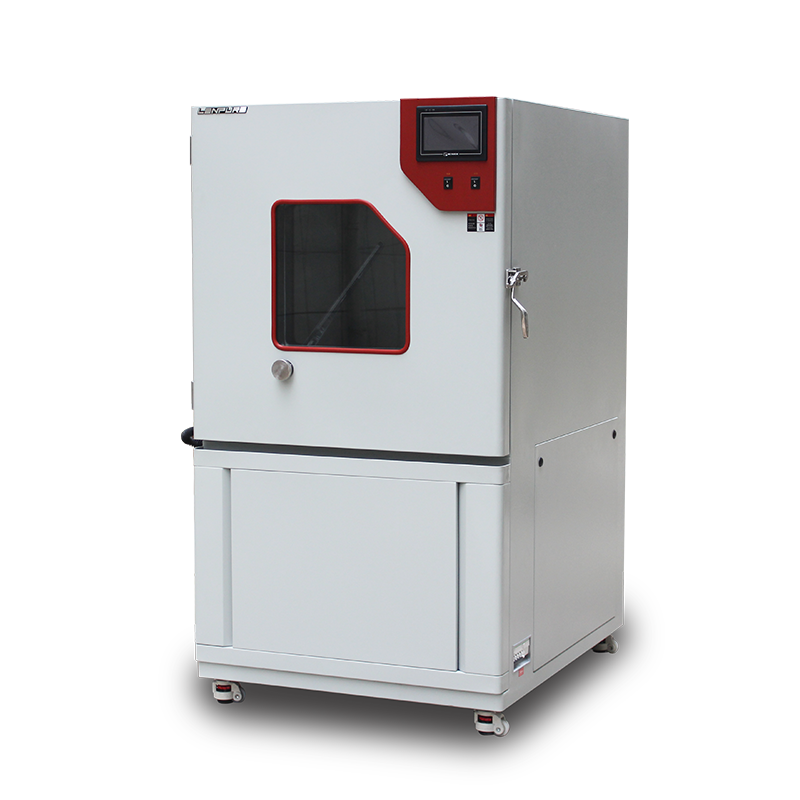
How are the parameters of the sand and dust test chamber timer controller set? Here’s a guide: Today, we’ll share the detailed steps for operating the timer controller.
Before operating the timer controller of the sand and dust test chamber, ensure that the power is connected, as these operations must be performed with the power on. Initially, the controller display will show the main menu: Run, Function Block, Clear Program, etc.
Access the Function Block
Press the Up/Down Arrow keys to move the cursor to Function Block, then press OK (Confirm).
The screen will display “T1” (Test Time) in the lower right corner, with the cursor blinking on “T1”.
Set the Test Time (T1)
Press the Left/Right Arrow keys to move the blinking cursor to the time setting position.
Observe the time unit displayed in the upper left corner of the screen.
Press SEL, then use the Up/Down Arrow keys to adjust the desired time value.
Press OK to confirm, and the cursor will return to “T1”.
Set Blowing Dust Time (T2)
Press the Up Arrow and SEL keys simultaneously—the screen will display “T2” (Blowing Dust Time, recommended: 5 minutes).
Follow the same method as T1 to set the time.
Set Blowing Dust Stop Time (T3)
Press the Up Arrow—the screen will display “T3” (Stop Blowing Dust Time, recommended: 2 minutes).
Set it using the same method as T1.
Set Vibration and Power Times (T4-T7)
T4: Vibration Time (recommended: 0.5 seconds).
T5: Stop Vibration Time (recommended: 2 minutes).
T6: Power-On Time (set according to relevant standards).
T7: Power-Off Time (also set according to standards).
Complete Setup and Start the Test
After setting all 7 time parameters, press ESC (Exit) to return to the main menu.
Use the Up Arrow to move the cursor to “Run”, then press OK—”Run” will change to “Stop”, and the internal power will activate.
The temperature controller will display readings. Press ESC again to return to the control screen.
Begin the Test
Turn on the “Blowing Dust” and “Vibration” switches—the device will start working.
To begin the test, turn on the “Sample” switch.
That’s all for the operation steps of the sand and dust test chamber timer controller. By reading this guide, you should now have a clear understanding of the process.






Copyright © 2025 Shanghai Linpin Instrument Co., Ltd Copyright
| ICP Number:Shanghai ICP Record No. 12029585-7
| Sitemap






 EN
EN
 中文
中文 Pусский
 Tiếng Việt
 ภาษาไทย
 پاکستانی زبان